
Write first. Ask AI second.
The students who used AI latest in their process got the highest grades — higher even than classmates who skipped AI entirely. The trick isn’t a tool or a rule. It’s an order of operations, and the same sequence is easy to run at the kitchen table.
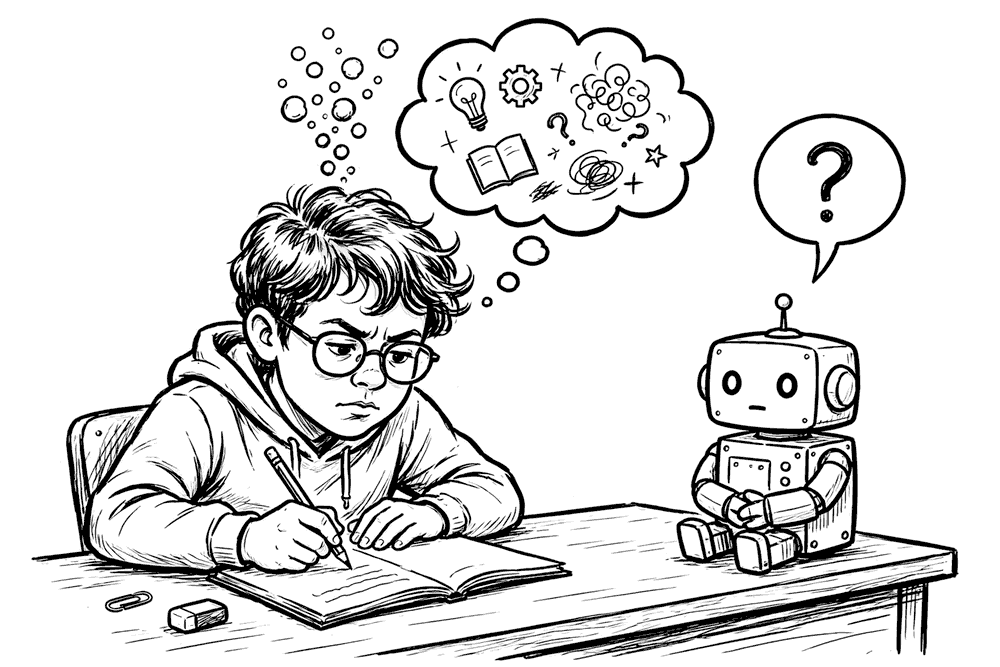
Most arguments about kids and AI start in the wrong place. They ask whether AI belongs in homework at all, as if the answer were a yes or a no. A new piece of research suggests the more useful question is a sequencing one: in your child’s study session, who goes first — the student or the machine?
Three ways to use AI. Only one wins.
Researchers at the University of Eastern Finland analysed take-home exams from 891 university students across 2023 and 2024. Students were allowed to use AI as long as they disclosed it; 159 did. The team sorted those students’ approaches into three patterns (source: Hakola et al., Computers in Human Behavior Reports, 2026, via phys.org):
- Instrumental use — handing the assignment to AI and submitting what comes back, with little critical reflection or revision.
- Ideational use — asking AI to generate ideas and perspectives, then building on them.
- Reflective use — writing your own content first, then asking AI for feedback or for perspectives you’ve missed.
The results were not subtle. Reflective users earned the highest grades of anyone — higher than ideational users, higher than instrumental users, and higher than students who didn’t use AI at all. Instrumental users, at the bottom, could end up scoring below classmates who never opened a chatbot. Ideational use landed in the middle: better than outsourcing, but with a catch the researchers flagged — students tended to trust AI-generated ideas more than those ideas deserved.
One honest caveat before we build a family routine on this: these were university students writing take-home exams, the AI use was self-reported rather than assigned, and the study shows association, not a controlled experiment. Treat it as strong directional evidence, not a guarantee. But the direction is exactly what decades of learning science would predict.
Why the order works
Learning researchers have long known that producing something — anything — before receiving help changes what the help can do for you. It’s called the generation effect: material you generate yourself is remembered better than material you merely read (source: generation effect research, summarised in Bjork & Bjork’s work on “desirable difficulties”). Retrieval practice research makes the same point from another angle: students who try to recall and produce answers, even imperfectly, retain far more a week later than students who simply re-study — in one well-known experiment, the retrieval group outperformed re-readers by more than 50% after a week (source: Roediger & Karpicke, 2006).
The mechanism is intuitive once you see it. A first draft — even a rough one — forces your brain to organise what it knows and, just as importantly, to expose what it doesn’t. Feedback then lands on a structure that already exists. It has something to attach to. Ask AI first and the sequence inverts: a polished answer arrives before the student has located their own gaps, so the gaps never get found, let alone filled. The Eastern Finland results read like the same law operating in a new tool: the draft is the learning; the feedback is the polish. Skip the draft and you’ve polished something that was never built.
This is already most children’s normal
If this feels like a niche concern, the numbers say otherwise. In Hanover Research’s National AI Usage in K-12 Survey, 54% of parents and staff reported that students use AI tools for schoolwork, and 41% of staff said they’d had to make significant changes to their teaching practices to use AI effectively (source: Hanover Research, October 2026). In other words: AI is already in the homework routine for most families, and teachers are already redesigning around it. The question in your house isn’t whether AI shows up. It’s whether it shows up in minute one or minute twenty-six.
The draft-first routine
You don’t need to police this. You need a sequence that’s easier to follow than to skip. Here is the four-step version:
1. The 25-minute draft sprint. Timer on, chatbot closed. Your child writes the essay paragraph, works the maths problems, or drafts the explanation in their own words — rough is fine, wrong is fine. The only rule is that the words and attempts are theirs. For younger children, make it talk-first: they explain the topic aloud for three to five minutes while you (or a voice recorder) listen, before anything gets typed anywhere.
2. AI as critic, not author. Only now does the chatbot open — and only with prompts that demand questions back instead of rewrites. Copy-ready examples:
Here is my draft. Quiz me, don’t rewrite me. Ask me questions until I can explain every part of it myself.
Point at my weakest paragraph and ask me a question about it. Don’t fix it — make me fix it.
What important perspective is missing from my argument? Name it, but don’t write it for me.
3. Revise in their own words. Every change your child accepts gets re-typed by them, in their phrasing — never pasted. If they can’t rephrase it, they don’t understand it yet, and the prompt becomes: “Explain that idea to me like I’m two years younger, then I’ll try.”
4. The teach-back close. Two minutes, book closed, chatbot closed: your child explains the topic to you out loud. If they can teach it, the session worked. If they can’t, that tells you both exactly where tomorrow’s draft sprint should start.
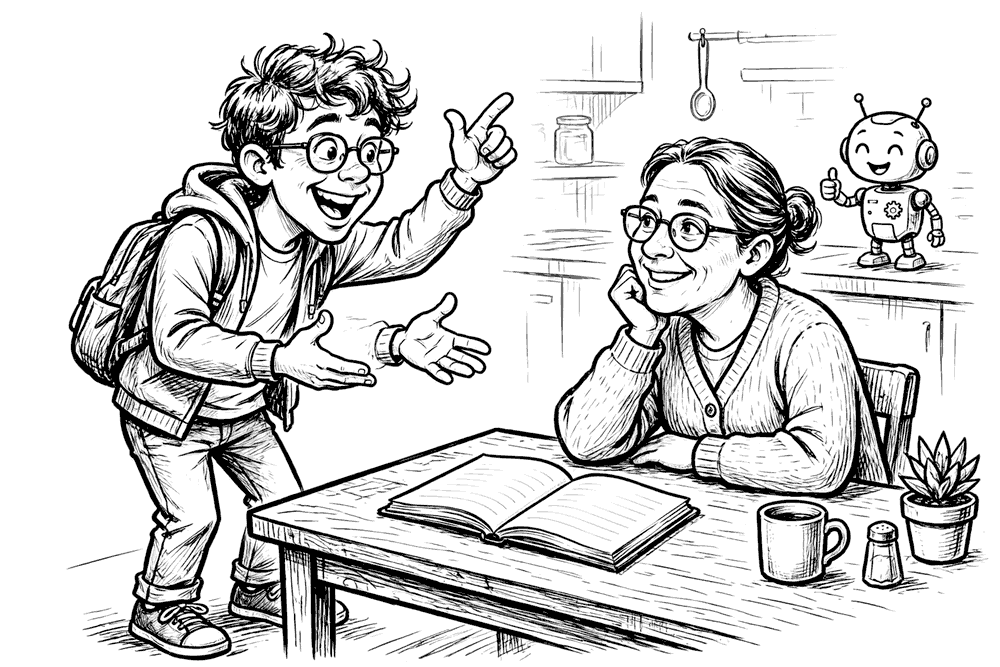
How do you spot the difference at the kitchen table without becoming the homework police? Listen for ownership. A child who drafted first talks about their argument and disagrees with the chatbot sometimes: “It told me to add a counterpoint, but I think it’s wrong.” A child who started with AI reads the screen back at you. The first sound is an author defending choices; the second is a courier delivering a package. You don’t need to inspect anything — just ask one question: “Show me the bit you wrote first.” In a draft-first household, there’s always an answer.
Tonight’s 40-minute session
0–25 min — Draft sprint. Timer visible, AI closed. Pen, keyboard or voice notes — their words only. Messy counts.
25–32 min — Critic round. Open the chatbot with one prompt from step 2 above. Questions and missing perspectives only; no rewrites allowed.
32–38 min — Own-words revision. They re-type every accepted change themselves. Anything they can’t rephrase gets explained, then retried.
38–40 min — Teach-back. Book shut. They teach you the topic in two minutes. Note where they wobble — that’s tomorrow’s starting line.
The bigger lesson hiding in the data
The finding that should quieten the loudest argument in this debate is the one at the bottom of the table: students who delegated wholesale to AI could do worse than students who used no AI at all — while students who used it last did best of all. AI in study is neither the cheat code nor the shortcut to ruin. It’s a sequenced tool, and sequence is something a family can actually control. No bans, no surveillance software, no nightly standoff. Just a house rule with a timer: you go first, then it gets a turn.
Sources
- Hakola, O. et al., “Self-regulated approaches to students’ generative AI use in higher education,” Computers in Human Behavior Reports (2026), DOI: 10.1016/j.chbr.2026.101340 — reported at phys.org, “Using AI for feedback, not ready-made answers, may help students earn higher grades,” 7 October 2026.
- Hanover Research, “National AI Usage in K-12 Survey” — 54% of parents and staff report students use AI tools for schoolwork; 41% of staff report making significant changes to teaching practices (press release, October 2026).
- Roediger, H. L., & Karpicke, J. D. (2006) — retrieval practice research; students who practised recall outperformed re-study groups by more than 50% at one week.
- Bjork, R. A., & Bjork, E. L. (2011), “Making things hard on yourself, but in a good way” — on generation and other “desirable difficulties” in learning.
Free newsletter
Get guides like this in your inbox
Practical AI for parents, teachers, and everyday people. Copy-paste ready. Always free.