
Two AIs are now fighting over your job application. Here’s how to win — without lying.
You send the application at 9:14 on a Tuesday night. At 9:21 your phone buzzes: rejected. No human read it. No human could have. This is the 20-minute routine that gets a real application past the first machine and in front of a human — without inventing a single thing.
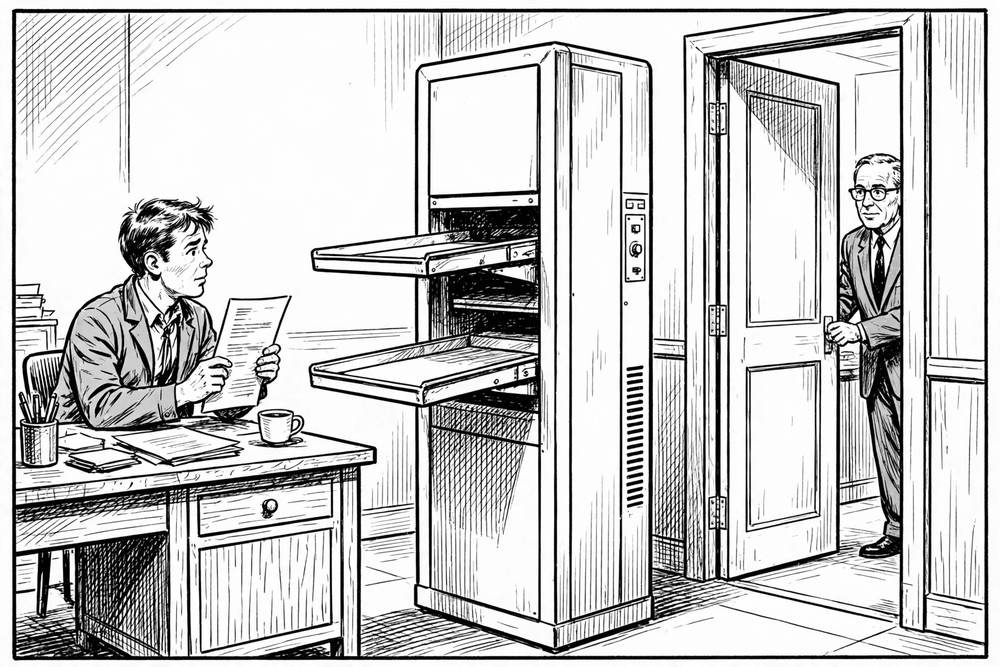
You send the application at 9:14 on a Tuesday night. CV polished, cover note written, the role a genuinely good fit — three years doing exactly what the ad asks for. At 9:21 your phone buzzes. Thank you for applying. After careful consideration, we have decided not to proceed with your application.
Seven minutes. No human read it. No human could have.
That is not a glitch in the hiring process any more. It is the process. On one side, an AI screened you out before a person ever saw your name. On the other side, roughly four in five job seekers are now using AI in their job search. Two machines are fighting over your career, and the person in the middle — you — is the only one who can make either of them tell the truth.
This piece is the 20-minute routine that gets a real application past the first machine and in front of a human, without inventing a single thing.
The numbers, first — because they explain the seven minutes
| What is happening | The figure | Source |
|---|---|---|
| Job seekers using AI in their search | 77% in the US; 78% in the UK and Ireland; 87% in Germany; 84% in Australia | Greenhouse, Future of Hiring Candidate Report 2026 (October 2026) |
| Hiring managers using AI in at least one stage | 87% | Resume Genius 2026 |
| Hiring managers who say AI automatically rejects some applicants before a human reviews them | 65% | MyPerfectResume, March 2026 |
| Employers who say qualified high-skills candidates are screened out by automated filters | 88% (94% for middle-skills workers) | Harvard Business School / Accenture, ‘Hidden Workers: Untapped Talent’, September 2021 |
| Recruiting leaders who say AI-generated resumes are commonplace | 92% | Criteria Corp / Lighthouse 2026 |
| Recruiting leaders who say they have hired someone who misrepresented their skills | 64% | Criteria Corp / Lighthouse 2026 |
Read those two columns together and the picture is clear. The screening AI is rejecting real people, and the flood of AI-written applications is part of why employers trust the filter in the first place. In a Stanford-led study published in 2026, researchers analysed 4 million applications submitted between December 2018 and December 2022 — all of them screened by algorithms from a single vendor. Among candidates who applied to four positions, 10% were rejected from all four. That is not four employers reaching the same conclusion independently: the vendor screens applicants on their performance in online games, not on their CV, so every one of those rejections came from the same algorithm. One shared system can shut a person out of several employers at once.
None of this means the filter is unbeatable, and none of it means you should join the arms race by faking a better CV. It means the application has to be written for two readers in sequence: the machine first, the human second — and the machine reader is literal, tireless, and entirely humourless about synonyms.
Why the machine rejected you
A screening system does not read your CV the way a person does. It does not infer, give the benefit of the doubt, or notice that “ran the checkout rebuild” and “led re-platforming of payments” are the same job. Roughly, it does three things:
- It matches words. It scores your application against the skills and phrases in the job ad. A skill you have but describe in different words scores as a skill you do not have.
- It parses structure. Fancy tables, text boxes, graphics and two-column layouts can scramble the order it reads things in — or drop whole sections. A human admires the design; the parser sees soup.
- It ranks, then cuts. Past a certain volume of applicants, some systems forward only the top scorers to a human and discard the rest — imagine it forwarding the best 20 by its score. Being the 21st-best real candidate is then the same as being the worst. That is not how every system works: in a 2026 survey, only 6% of hiring managers said AI could move candidates forward or reject them with limited human review.
That is why the seven-minute rejection stings so much and explains so little. You were not judged. You were sorted.
The 20-minute routine
Do this for every application that matters, before you press send. Twenty minutes, five steps, in order.
Step 1 — Mirror the ad’s exact words, with real evidence behind each one (8 minutes)
Open the job ad next to your CV. For each skill the ad names — the required ones first — check whether your CV uses the ad’s exact phrase for it. Not a synonym. The exact phrase.
If the ad says “stakeholder management” and your CV says “worked with teams across the business,” the machine may not connect them. Change the CV line to use the ad’s phrase — and keep the evidence that proves it. “Stakeholder management: coordinated the rollout across product, legal and support in three markets” is a mirrored phrase with a real fact behind it. The phrase gets you past the filter; the fact gets you past the human.
Do not add a skill you do not have, however tempting the mirror makes it look. The mirror is about translation, not invention — and Step 5 is where that line gets enforced.
Step 2 — Make it machine-readable (3 minutes)
Save the CV as a plain, single-column document. One font, ordinary headings — Experience, Education, Skills — and bullet points, not tables or text boxes. Dates in a plain format. No header or footer carrying your contact details, because some parsers never read headers at all; put your name, phone and email in the body of the first page.
Then do the five-second test: copy all the text out of the file and paste it into a blank document. If it comes out in the right order and nothing is missing, the parser will probably read it too. If a whole section vanishes or the bullets scramble, fix the formatting before anything else. This is the cheapest three minutes in the whole routine — a beautiful CV the machine cannot read scores zero.
Step 3 — Quantify three achievements (5 minutes)
Pick the three achievements closest to this role and put a number on each: people, money, time, scale. Not adjectives — numbers.
- “Led a team of 12 engineers across two countries” beats “led a large team.”
- “Cut checkout failures by 18% in six months” beats “improved checkout reliability.”
- “Shipped to 4 million users” beats “shipped at scale.”
Numbers do two jobs at once. The screening system scores them as concrete evidence, and the human who eventually reads them can picture the work. If you genuinely do not know the number, say what you do know — “the team’s largest market” — rather than guessing one. A guessed number is an invented fact, and invented facts are where this routine stops.
Step 4 — Run your own AI check, against the ad (3 minutes)
This is the one step that uses AI on your side, and it is the step most people skip — then wonder why the filter disagreed with them.
Paste the job ad and your CV into your usual chatbot and ask it one question: “Which required skills in this ad are missing or only implied in my CV, and quote the exact lines?” Read the answer sceptically. The chatbot will sometimes hallucinate a gap that is not there, and sometimes miss one that is. Use it as a second pair of eyes, not a judge: for each gap it names, check the CV yourself, and fix the real ones with Step 1’s mirror-and-evidence method.
Two safety rules for this step. First, paste the ad and your CV only — never identity documents, never your passport or national ID number, never a full address history. A CV is already a document you send to strangers; an ID is not. Second, use a fresh chat and delete it afterwards if the tool offers that. Your employment history is your data; do not leave it sitting in a chatbot’s memory by default.
Step 5 — The honesty line (1 minute)
Read the finished application once, top to bottom, and ask of every claim: “Could I defend this in an interview, with a named example?” If the answer is no, cut it or rewrite it until the answer is yes.
This is not politeness. It is self-protection. Nearly two in three recruiting leaders say they have hired someone who misrepresented their skills — and the discovery, when it comes, costs the job. AI rewrites your real experience; it never invents one. The moment the application claims something you cannot evidence, you have stopped optimising and started lying, and the lie is the part the human interview is designed to catch.
What not to do
- Do not let AI write the application from a two-line prompt. The result reads like everyone else’s AI-written application, because it is. The filter has seen thousands of them.
- Do not keyword-stuff. A hidden block of ad phrases in white text or a skills section listing everything under the sun reads as gaming the system to a human. And the trick is no longer secret: 41% of job seekers admit to ‘hacking’ AI systems with prompt injections — hidden text designed to bypass the filter (Greenhouse, 2025).
- Do not auto-apply. Tools that fire off dozens of applications a day trade the one thing that matters — the mirror in Step 1 — for volume. Ten tailored applications beat a hundred identical ones.
- Do not pay anyone who promises to “beat the ATS.” There is no secret handshake with the filter. There is a readable document, the ad’s own words, and evidence.
The law is starting to notice
This is not only a tactics problem; the rules are moving. In Illinois, employers have had to disclose their use of AI to candidates since 1 January 2026. In the EU, the AI Act classes hiring AI as high-risk, with the employer obligations in that area postponed to 2 December 2027. Neither law helps you get past today’s filter — but both point the same way: the screening is real, it is regulated, and it is not going away. The routine above works under any version of the rules, because it does not depend on a loophole. It depends on being legible and truthful.
Try it on your next application
| Step | Time | Done? |
|---|---|---|
| Mirror the ad’s exact words, with evidence | 8 min | ☐ |
| Make it machine-readable, paste-test it | 3 min | ☐ |
| Quantify three achievements | 5 min | ☐ |
| Run your own AI check against the ad | 3 min | ☐ |
| Honesty line: can I defend every claim? | 1 min | ☐ |
Twenty minutes. No invented skills, no ID documents in a chatbot, no auto-apply. The filter is a machine that matches words and counts evidence; give it words it recognises and evidence it can count, and the next application stands a real chance of reaching the person it was written for — the human who can actually say yes.
Sources
- Greenhouse, Future of Hiring Candidate Report 2026 (October 2026) — 77% of US job seekers use AI in their search; 78% in the UK and Ireland; 87% in Germany; 84% in Australia.
- Resume Genius, 2026 — 87% of hiring managers use AI in at least one stage.
- MyPerfectResume, March 2026 — 65% of hiring managers say AI automatically rejects some applicants before a human reviews them.
- Harvard Business School / Accenture, ‘Hidden Workers: Untapped Talent’ (September 2021) — 88% of employers say qualified high-skills candidates are screened out by automated filters; 94% for middle-skills workers. The report predates generative AI. HBS PDF
- Criteria Corp / Lighthouse, 2026 — 92% of recruiting leaders say AI-generated resumes are commonplace; 64% say they have hired someone who misrepresented their skills.
- Stanford-led study (Bommasani et al., ‘Algorithmic Monocultures in Hiring’, FAccT 2026) — 4 million applications submitted December 2018–December 2022, all screened by one vendor (pymetrics) on online-game performance; among candidates who applied to four positions, 10% were rejected from all four. arXiv
- Illinois law — employers must disclose AI use to candidates from 1 January 2026.
- EU AI Act — hiring AI classed as high-risk, with obligations postponed to 2 December 2027.
Free newsletter
Get guides like this in your inbox
Practical AI for parents, teachers, and everyday people. Copy-paste ready. Always free.