
Ten minutes with AI — and then they gave up faster
Ten minutes of AI help didn’t just fail to teach — in randomized trials, it made people less persistent once the help was taken away. Here’s the rule that puts the struggle back first.
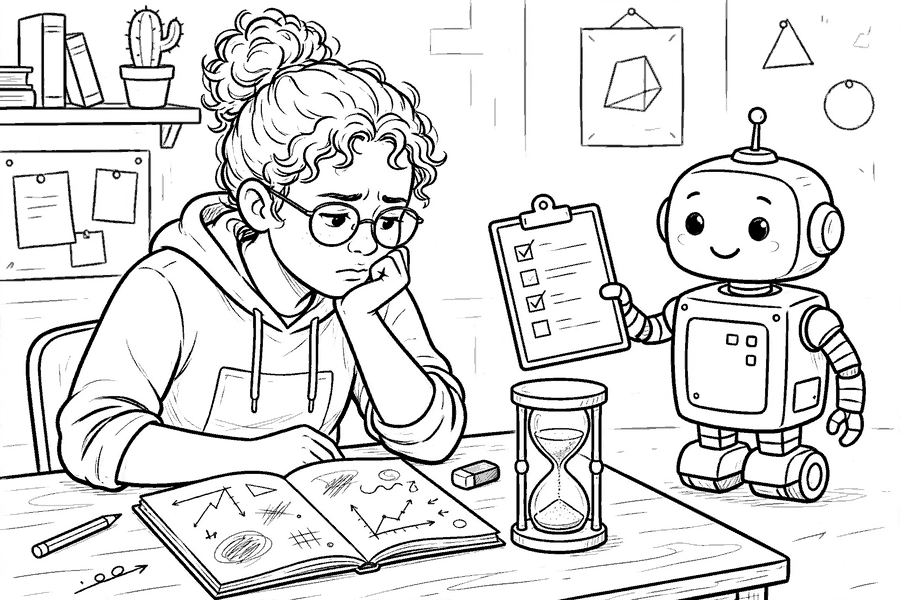
Your child is stuck on a hard problem. They open a chatbot, get the answer in ten minutes, and move on. Homework done, everyone happy. Then the next day, on a similar problem with no chatbot in sight, they quit sooner than they would have before.
That last part is not a guess. In randomized trials co-authored by researchers at UC Berkeley, people who used AI for just ten minutes performed worse once the AI help was taken away. On an SAT-style reading task, accuracy fell after the tool was removed. Ten minutes of help didn’t just fail to teach — it actively made people less persistent at the hard thing.
Why help that arrives too early costs so much
Struggle is not wasted time. When a student wrestles with a problem, two things happen that no answer sheet can deliver. First, the brain builds a path to the solution — the false starts, the backtracking, the moment something clicks. Second, and more importantly, the student builds evidence about themselves: I can stay with a hard thing and come out the other side.
AI help that arrives in the first minute skips both. The student gets the answer without the path, and without the proof that they can persist. Do that often enough, and quitting early starts to feel normal. The next hard task doesn’t just feel hard — it feels like the kind of thing you hand to the machine.
This is the same pattern behind a second, larger finding. Across 26,811 students in grades 7–12, homework scores rose 18% and homework time fell 30% within six months of generative AI arriving — but monthly closed-book exam scores fell 20%. The damage wasn’t spread evenly: it sat almost entirely with the students whose suspiciously fast homework marked them as outsourcers. Students who kept their normal pace showed only small declines. Speed was the tell. The faster the homework, the thinner the learning.
What this doesn’t prove
One study is not a verdict on AI in education, and this one has limits worth naming. Lab tasks are not classrooms, and a short experiment can’t tell us how habits compound over a school year. AI help is also genuinely useful in many moments — for a student who is truly stuck after real effort, a hint can be the difference between learning and shutting down entirely. The problem is not AI. The problem is the order: help before effort.
The 10-minute rule
Here’s the rule I’d put in every home this month. It’s simple enough for a child to run themselves:
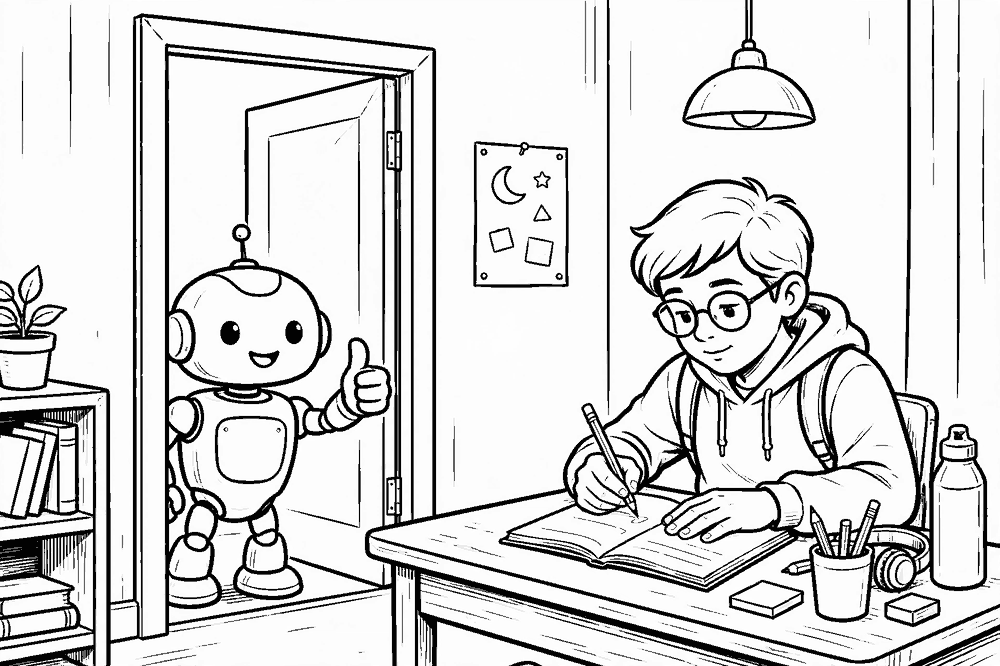
- Timer on, chatbot closed. Ten minutes alone with the problem. Notes, textbook, and their own brain are all allowed. The chatbot is not.
- Write down where you got stuck. Not “I don’t get it” — the specific step. “I got the equation set up but I can’t isolate x.” That sentence is the most valuable thing in the whole session, because it tells the helper exactly where to aim.
- Now ask AI — as a critic, not an author. “Here’s where I’m stuck. Give me a hint, not the answer.” Or: “I solved it this way — check my working.” The AI’s job starts after the struggle, not instead of it.
- Close the loop. Cover the answer and redo the problem from scratch. If you can’t, you didn’t learn it yet — and that’s useful information, not failure.
For teachers, the same rule works as a classroom routine: five minutes of solo attempt before any AI tool opens. For parents, the tell to watch for isn’t screen time — it’s speed. Homework that used to take forty minutes and now takes ten is not efficiency. It’s outsourcing, and the exam will eventually ask for the receipt.
The habit underneath the habit
There’s a deeper point here that applies well beyond homework. Every tool that removes friction also removes the repetitions that build capability. A calculator doesn’t weaken arithmetic if you learned arithmetic first; it weakens it if it arrives before you did. AI is the same. Used after effort, it’s a tutor. Used instead of effort, it’s a crutch — and crutches, used long enough, change how you walk.
So the question to ask about any AI habit, for a child or for yourself, is not “does it work?” It works beautifully. The question is: what did I stop doing because it works? If the answer is “the struggling” — put the ten minutes back. The struggle was never the obstacle. It was the lesson.
Sources
- UC Berkeley News (October 2026) on the 10-minute AI persistence trials — randomized trials; accuracy on an SAT-style reading task fell once AI help was withdrawn.
- Study of 26,811 students in grades 7–12 on homework scores (+18%), homework time (−30%), and closed-book exam scores (−20%) within six months of generative AI use.
Free newsletter
Get guides like this in your inbox
Practical AI for parents, teachers, and everyday people. Copy-paste ready. Always free.