
Application season without the spreadsheet chaos
Six schools, eleven deadlines, three essay versions called “final” — and a fridge door covered in sticky notes. Application season doesn’t have to run your household. Here’s the calm, AI-assisted system that keeps every date, document and draft in one place, whichever country you’re applying from.
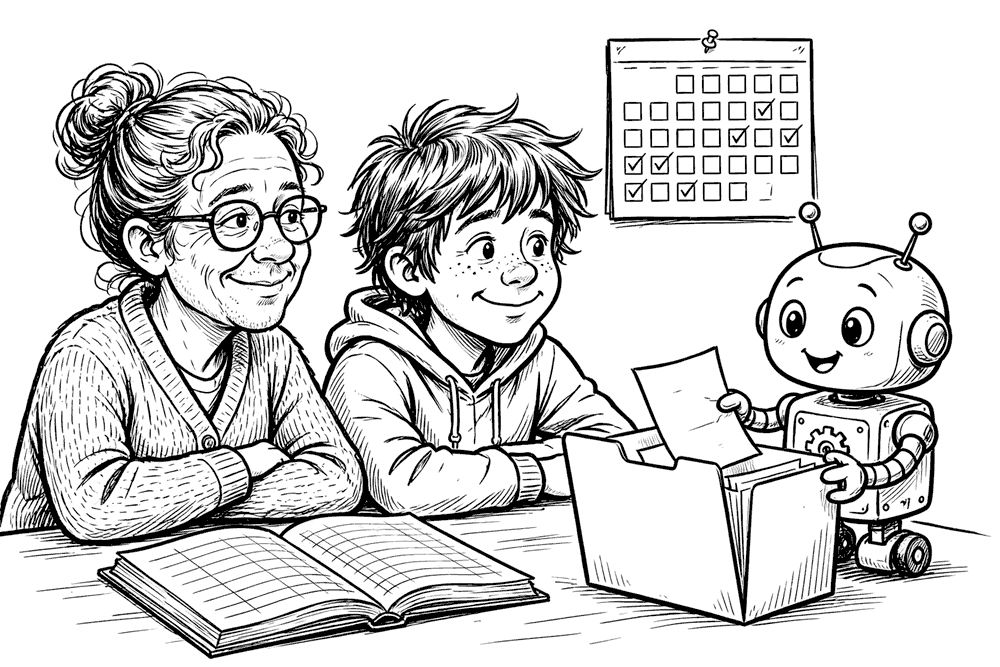
If your family is in application season, you already know the real enemy. It isn’t the essay or the grades. It’s the admin: every university wants slightly different things, on slightly different dates, through slightly different portals — and missing one line in a requirements list can cost the whole application.
This is the part of the process AI is good at. Not choosing the school. Not writing your teen’s story for them. Just holding the whole messy project in its head so you don’t have to.
What’s new: ChatGPT is getting a College Planner
On 7 October 2026, OpenAI announced a College Planner for ChatGPT for Teens, its under-18 experience. The idea is exactly the one above: pull each school’s requirements, deadlines, tasks and financial-aid steps into one plan, track progress on a timeline, and ask questions along the way — what a requirement means, how to start it — plus scholarship and fee-waiver help. (source: OpenAI, “Helping teens learn, plan, and shape the future of AI”, 7 Oct 2026, openai.com/index/teens-learn-and-plan/)
Two honest caveats before anyone reorganises their life around it:
- It’s announced, not in your hands yet. OpenAI has said the planner is arriving “in the next few weeks,” with no firm launch date published yet. Treat it as coming, not available. (source: Fox Business, 8 Oct 2026; RuntimeWire, 7 Oct 2026)
- It’s US-first. The initial version is designed for US students in grades 10–12 applying to four-year colleges. OpenAI says other countries, two-year colleges, technical colleges and trade schools will follow “over time” — no dates given. (source: OpenAI announcement as reported by Unite.ai and DigWatch)
Notice what OpenAI itself says the tool is for: managing the practical steps of applying. Where to apply stays with students, families and counsellors. (source: OpenAI announcement as reported by IndexBox) That’s the right line — and you don’t need to wait for the feature, or live in the US, to run the same system. Any AI assistant you already use, plus one shared document, can do the organisational heavy lifting today.
The system: one ledger to rule the season
Forget the fridge door. Your family needs a single deadline ledger — one table every application flows through, visible to both parent and teen. Ask your AI assistant to build the skeleton, then fill it in together from each university’s official admissions page.
| School | Deadline | What’s due | Status | Owner |
|---|---|---|---|---|
| Example State University | 1 Nov | Application form, transcript, personal statement v-final | In progress | Teen |
| Example City University | 15 Nov | Application, 2 recommendation letters, portfolio | Letters requested | Parent to remind |
| Example Coastal College | 1 Dec | Application, financial-aid form, English test score | Not started | Teen |
| Example Technical Institute | 15 Dec | Application, transcript, interview booking | Booked | Parent |
Four columns do the quiet work. What’s due stops the “I thought it was just the form” surprise. Status makes progress visible without nagging. Owner ends the assumption that someone else was handling it. Everything else — calendar reminders, the Sunday check-in — hangs off this one table.
The documents vault: gather once, use everywhere
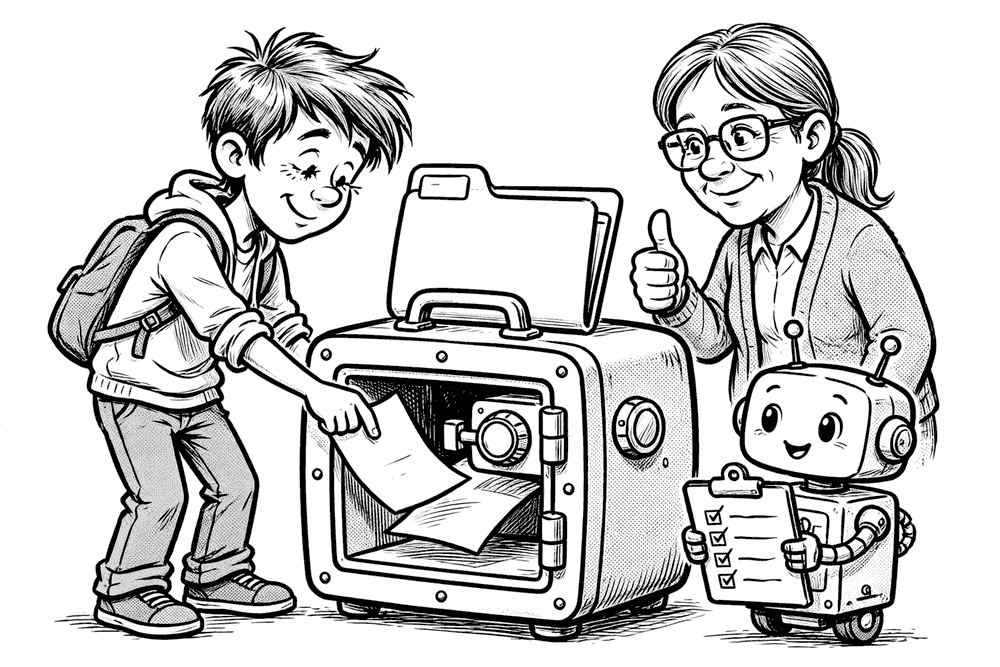
Applications stall less on writing than on hunting: the transcript in an email somewhere, the test-score PDF named “scan_final2”. Before deadlines bite, assemble a documents vault — one folder, cloud or local, both of you can open. Your AI can turn your pile into the checklist below; the gathering is still yours.
- School transcript (latest available version)
- Standardised test scores, if your schools require them
- English-language test score, if applicable
- Recommendation letters (requested / received — track both states)
- Personal statement and each school’s supplementary essays
- Financial-aid forms and supporting documents your schools ask for
- Certificates for achievements you plan to cite
- A one-page activity/awards list you can copy from, so every form describes them consistently
Two rules for the vault. First, name essay drafts like adults: PersonalStatement_v3_2026-11-02 — never “final”, because it never is. Keep one master document per essay and let the version number do the talking. Second, the vault is a folder, not a chat thread: real documents live there, and an AI only ever hears them described in general terms (see the guardrails below).
Three prompts worth copying
You are helping our family organise university applications. Here is our school list: [paste school names]. Build a deadline ledger table with columns: School, Deadline, What’s due, Status, Owner. Leave dates blank where I haven’t given them — do not guess dates. After the table, list the five questions you need me to answer to complete it.
Here is our current deadline ledger: [paste table]. Today is [date]. Write a short summary for our family check-in: what is due in the next 14 days, what is overdue or stalled, and the single most important task to finish this week. Keep it to five bullet points, no new dates invented.
For [school name], here is what I believe is required and done so far: [paste your list]. Act as a sceptical checklist editor: what do applicants commonly forget for this type of application — recommendation logistics, supplementary essays, aid forms, interview bookings, sending official scores? Flag anything I should verify on the university’s own website. Do not invent requirements or dates.
Prompt 3 is worded that way for a reason: AI is excellent at what usually exists, and unreliable about what this university wants this year. Let it generate the questions; answer them on the official site.
Guardrails that keep this safe
- AI never chooses the list. Where to apply is a family decision shaped by fit, cost and counsel from real humans. Let AI administer the list, never write it.
- Verify every date on the university’s own admissions page. Deadlines shift, rounds differ (early vs regular), and time zones have ended applications. The ledger records what you confirmed, from the source.
- Never paste ID numbers or financial documents into a chatbot. Passport numbers, national ID numbers, bank statements, tax records — these live in the vault folder and the official application portal, nowhere else. Describe, don’t upload.
- Your teen’s voice stays your teen’s. AI can check an essay’s structure and spot a missing requirement; the story, examples and sentences should be theirs. Admissions readers can tell, and so can your teen.
Your 20-minute Sunday setup
- Minutes 0–5: Open the ledger together. Anything submitted this week? Mark it, celebrate briefly, move on.
- Minutes 5–10: Run prompt 2 (weekly nudge summary) with the updated table. Read the five bullets aloud.
- Minutes 10–15: Pick the one task that matters most this week and put a name next to it in the Owner column.
- Minutes 15–20: Check the vault: any document still missing for the next deadline? Request it now, not the night before.
Then close the laptop. Application season is a project with a Sunday meeting — the other six days belong to your family.
The tools will keep improving; a built-in planner inside ChatGPT may soon make this skeleton automatic for some families. But the calm doesn’t come from the feature. It comes from one ledger, one folder, twenty minutes a week — and an AI doing the remembering so you can do the supporting.
Sources
- OpenAI (primary source): “Helping teens learn, plan, and shape the future of AI” — official announcement, 7 Oct 2026, fetched and verified 10 Oct 2026: openai.com/index/teens-learn-and-plan/
- OpenAI announcement of College Planner and study tools for ChatGPT for Teens, 7 Oct 2026, as reported by Fox Business: foxbusiness.com
- Unite.ai, “OpenAI Announces College Planner and Study Tools for ChatGPT for Teens”: unite.ai
- RuntimeWire, “OpenAI folds college applications into ChatGPT for teens” (preview status, no release date given): runtimewire.com
- DigWatch, “OpenAI introduces new AI study tools for teenage students,” 8 Oct 2026: dig.watch
- IndexBox, “OpenAI Launches College Planner in ChatGPT for Teens,” 7 Oct 2026 (planner as process help, not school-choice): indexbox.io
Editor’s note: The College Planner details above were verified on 10 Oct 2026 against OpenAI’s own announcement (openai.com/index/teens-learn-and-plan/), which confirms the feature set, the grades 10–12 US-first scope, and expansion “over time” with no dates. The “in the next few weeks” launch timing is OpenAI’s as reported by Fox Business; the official post itself says only that the tool is coming “soon”. No exact launch date has been published, and the feature was not yet available at the time of writing.
Free newsletter
Get guides like this in your inbox
Practical AI for parents, teachers, and everyday people. Copy-paste ready. Always free.