
AI ethics isn’t taught evenly — so teach it at home
Knowing the rules turned out to be a separate skill from following them. Three short conversations, each anchored in something your child has already seen.
Here’s an uncomfortable finding: even university students studying computer science — the people you’d expect to be taught AI ethics most thoroughly — don’t develop it evenly. A three-year study of 350 computer-science undergraduates at two Nigerian universities tracked three dimensions of ethical engagement: awareness of the issues, reflection on them, and reported responsible use. All three grew. But they grew out of step with each other, barely tracking one another at all.
Knowing the rules, in other words, turned out to be a separate skill from following them. A student can score well on “AI ethics awareness” and still not behave differently when nobody is watching. If that’s true for computer-science undergraduates, it’s certainly true for school students, who mostly get no structured AI ethics teaching at all — just vibes, peer habits, and whatever the platform’s terms of service assume.
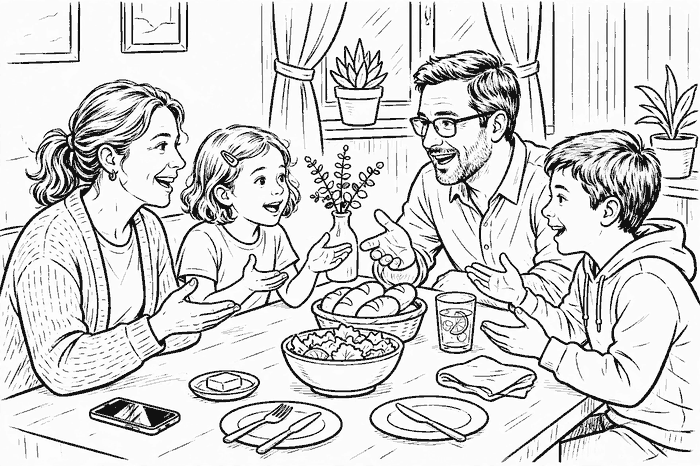
So the teaching falls to the dinner table. Not as a lecture — three short conversations, each anchored in something your child has already seen.
Conversation 1: Honesty — “Is it yours if the chatbot wrote it?”
Start with the question, not the rule. Ask: if a chatbot writes your essay and you hand it in, whose work is it? Most kids will say it’s theirs because they prompted it, or that it’s cheating because they didn’t write it — and both answers are a starting point, not an ending.
The useful distinction is authorship versus assistance. A calculator doing arithmetic is assistance; it doesn’t change whose thinking the answer represents. A chatbot writing the paragraph is authorship; the thinking in it isn’t yours. The line between them is the line your child will need for the rest of their life, because workplaces will ask the same question in fancier language.
The family rule that falls out of it: AI can help you think, not think for you. Brainstorming, outlining, checking — help. First drafts of the thing being graded — not help. When in doubt, the test is simple: could you defend every sentence in it if the teacher asked? If not, it isn’t yours yet.
Conversation 2: Copying — “Whose words are these?”
Kids understand plagiarism when it’s copying a classmate. AI makes it stranger: the words aren’t copied from anyone in particular, so it feels victimless. That’s the moment to introduce a second idea — that originality isn’t only about not stealing, it’s about what the work proves. An essay proves you can reason; a copied essay proves you can paste.
Try this at the table: show your child an AI-generated paragraph on a topic they know well, and ask them to find what’s wrong or missing in it. They usually can, quickly. That exercise teaches the deeper lesson better than any rule: AI output is raw material, not a finished product, and a person who can’t judge it can’t use it safely. Credit, then, isn’t just honesty — it’s quality control.
The family rule: if you use AI output, say so and show your working. The same standard as showing maths working. Nobody is punished for using a tool; they’re judged on whether they understood what it produced.
Conversation 3: Spotting fakes — “Would you believe this if it arrived from a stranger?”
This is the one that protects them outside school. Show them a convincing AI image or a too-perfect video clip — there are plenty in any news feed — and ask what would convince them it’s real. Most kids will check the source if prompted, but won’t think to prompt themselves. That’s the gap to close.
Teach the three-second check: source, motive, second source. Who posted it? What do they gain if you believe it? Does anyone independent say the same thing? That check takes seconds, works for homework sources and social media alike, and it’s the single most transferable skill in this whole article — it survives every platform change, because platforms change and manipulation doesn’t.
The family rule: don’t forward what you haven’t checked. One share of a fake is how fakes travel, and teenagers are the network now.
Why home, why now
Schools will catch up eventually — curricula always lag the technology by years, and AI ethics is no exception. But your child is using these tools tonight, not in the curriculum’s eventual chapter on them. And the study’s real warning is that awareness alone doesn’t change behaviour: a child who can recite the rules still needs practice applying them, in low-stakes moments, with someone they trust, before the high-stakes moment arrives.
Three conversations won’t make a child ethical. But three conversations, repeated across a school year, build something a lesson plan can’t: a habit of pausing before the tool does the thinking, asking whose work it is, and checking before believing. That’s the skill the undergraduates grew unevenly. Give your child a head start on growing it evenly — at home, at the table, this week.
Sources
- Three-year study of 350 computer-science undergraduates at two Nigerian universities on AI ethics awareness, reflection, and responsible use (awareness 2.99 → 3.75 on a six-point scale; dimensions grew out of step).
Free newsletter
Get guides like this in your inbox
Practical AI for parents, teachers, and everyday people. Copy-paste ready. Always free.