
The 3-minute homework check that beats any AI detector
A detector says “likely AI-generated.” Now what? Three minutes, no app, no accusation: check the work itself — the rough trail, one changed step redone cold, and one “why this step?” — and you’ll know what stuck and exactly where help should start.
You run the homework through a detector. It says “likely AI-generated.” Now what?
You have a percentage, not a conversation. You can’t show it to a child and expect learning to follow, and you can’t defend it either — the same tools that flag polished AI writing also flag human writing, and a lightly edited AI answer sails straight through. A detector judges the finished text. It never saw how the work was made.
So stop judging the product. Check the process instead. Three minutes, no app, no accusation. All you need is the homework, a pen, and one small change you make yourself.
The check, minute by minute
| Minute | Do this | You’re looking for |
|---|---|---|
| 1 | Ask to see the mess | Rough work, a crossed-out attempt, a first try |
| 2 | Change one thing, redo one step | The same skill, applied cold, without a screen |
| 3 | Ask one “why this step?” | A reason for a single decision, not a full explanation |
Minute 1 — Show me the mess
Say: “Show me where you got stuck, or your first try.”
Real thinking leaves a trail: a crossed-out line, a restarted calculation, a note in the margin, a draft sentence that got rewritten. A pasted answer leaves none. If the work is typed, the trail can be version history, an earlier draft, or notes — same idea, different place.
No trail is not proof of cheating. Some children work neatly, some tidy up before handing work in. Treat a missing trail as a reason to do minutes 2 and 3, not as a verdict.
Minute 2 — Change one thing, redo one step
This is the heart of the check, and it takes about sixty seconds. Pick one small part of the finished work, change it, and ask your child to redo just that part — on paper, screen closed.
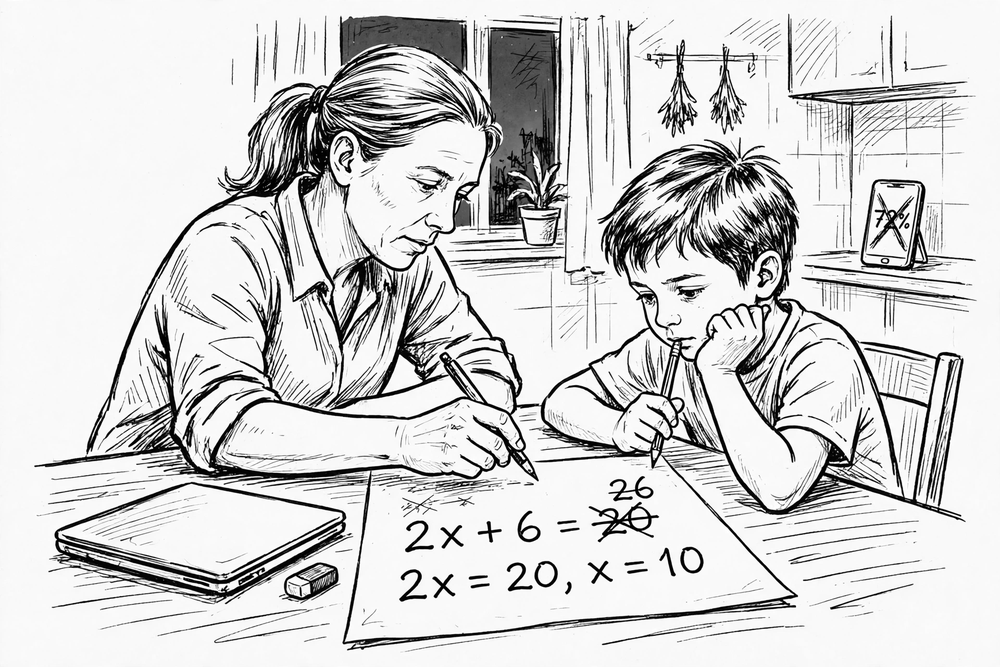
Worked example, maths. The homework says: solve 2x + 6 = 20. The answer is x = 7. You change one number: “Same question, but make it 2x + 6 = 26. Just that step.” The redo is 2x = 20, so x = 10. A child who did the original work gets there, maybe slowly. A child who only received the answer has nowhere to start — and that tells you more than any detector score.
Worked example, an essay. The homework argues that school should start later because teenagers need sleep. You change one premise: “Keep your first paragraph, but argue the opposite for one paragraph — school should start earlier. Give me one reason, in your own sentence.” Again, you are not asking for a second essay. You are asking for one decision, made fresh.
If your child can redo the changed step, the learning is there, whatever any detector says. If they can’t, you have found the exact place the understanding stops — which is exactly where help should start.
Minute 3 — One “why this step?”
Point at a single step in the original work and ask: “Why this step here, and not another one?”
This is not “explain the whole topic to me.” It is one decision: why divide here, why this piece of evidence first, why this word. A child who worked through the problem can usually answer for at least one step, even roughly. A child repeating a received answer often can’t answer for any step at all — the answer arrived whole, so no decision was ever made.
Read the result like this
| What you saw | What it means | What to do next |
|---|---|---|
| Trail + changed step done + one “why” answered | The work is theirs, detector or no detector | Tell your child you can see it’s their work, then drop it and carry on with the evening |
| Trail, but the changed step fails | They started it and got lost partway | Redo just that step together tonight, then re-check tomorrow |
| No trail and the changed step fails | The answer was almost certainly received, not worked out | No lecture, no detector printout: pick one problem and do it from scratch together, on paper |
Notice what none of these rows says: “punish” or “prove it.” The check is a diagnostic, not a court case. Its job is to find the gap, in three minutes, on a normal evening — not to win an argument about AI.
When the check doesn’t fit, bend it — don’t drop it
- No rough work because everything is typed? Use version history or the previous draft as the trail, and still do the changed step on paper.
- A subject with no numbers? Change a premise, a date, or a character’s choice instead of a number. The mechanism is identical: one fresh decision.
- A younger child? Skip minute 3. Trail plus one changed step is enough, and keep the changed step tiny.
- A child who gets upset? Say the frame out loud before you start: “I’m not checking whether you cheated. I’m checking which part is solid and which part needs another go.” If the evening is already tense, do it tomorrow — a check done calmly beats a check done tonight.
- Only one minute? Do minute 2 alone. The changed step is the single most informative minute of the three.
The script, ready to use tonight
“Show me your first try or where you got stuck. Now — same question, but I’m changing one number [or one premise]. Do just that step, no screen. And tell me why you did that step, not the next one.”
That is the whole routine. Copy it, use it as written, and it works for any subject, any age that does homework, and any school — no detector subscription, no account, no software.
Why this beats a detector, in one line
A detector asks: does this text look like AI? This check asks: can this child do one changed step without it? The first question can be gamed by editing and can wrongly accuse a human. The second question can’t be faked in sixty seconds — and when the answer is no, it hands you the exact next step instead of a percentage to argue about.
Detectors sell certainty. A three-minute check gives you something better: a true picture of what stuck, and a clear, calm next move when it hasn’t.
Free newsletter
Get guides like this in your inbox
Practical AI for parents, teachers, and everyday people. Copy-paste ready. Always free.